It is not our intention to fill these pages with long and boring recollections of plot and storylines. Our reviews will contain only the barest of essentials on that front and are meant more as a springboard for further investigation. While many of these films are over forty to fifty years-old they have lost none of their incredible vitality or ability to influence and inspire, and – we think, and hope you agree – are just as relevant and electrifying as they were when originally released.
CLICK THE LINKS
For further information about DVD releases - print and sound quality; extras, and availability - click the DVD comparison links.
For further information
about specific actors:
click the actor links.
Links to purchase available editions are also provided.
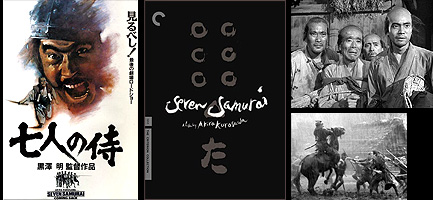
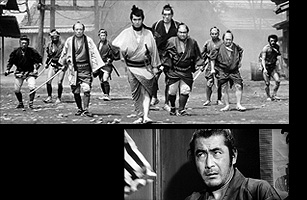
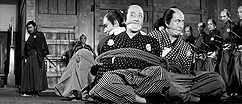
What can be said about Seven Samurai that has not been said before? Revered as a classic of world cinema; held in high regard by countless big name film-makers, used by midwives as an instruction video for expectant mothers... Actually that last line was a lie, but you get our meaning: Seven Samurai is a bloody good film.
Entertaining scenes
It's not that difficult to understand why either - none of the 207 minute running time is
wasted with filler.
All the characters are likable and believable and an unbelievable tension is built up over a series of hugely-entertaining scenes charting the lives of the titular samurai, protecting the lives of a village of bandit-threatened farmers. It all culminate in a big battle in the rain at the end. Sure: the film has it's quieter, more pensive moments, but overall it's a relentless film with lots of story and lots of interesting characters. Actor- wise Seven Samurai practically
cements at least twenty people into the All-Time Greats category. Mifune and Shimura are both at a pinnacle in their careers, though Minoru Chiaki (Heihachi), Isao Kimura (Katsushiro). Yoshio Tsuchiya (Rickichi), Daisuke Kato (Shichiroji) and Bokuzen Hidari (Yohei) all play memorable roles. The unique face of Bokuzen Hidari - a man who's fizzog has become a comic book icon in Japan - is particularly memorable.
But Seven Samurai is not one
of those dull "actor movies" with lots of pointless dialogue -
it has an honesty and a heart that shines through brightly.
Three hour ride
Watching Seven Samurai is a bit of a commitment - three hours is 180 minutes, and this is 207 minutes. That said: the intermission is included in this running time and lasts for around 10 minutes, so can be scratched-off the commitment with deft use of chapter search. But it's worth the commitment - a three-hour
film that teaches a lot is better than a 90 minute Tony Scott picture. Or Paul Anderson's Event Horizon. Why put up with stuff like that when there are gems such as Seven Samurai available? Don't think "uh, but it's subtitled..." - the subtitles are very simple and you don't have to read them all anyway - plus you can use picture search if you miss any. Seven Samurai is a film that is worth seeing because it is funny, gripping and realistic. It might not be
modern and we might have some problems relating to a bunch of 17th Century peasants. but the overall themes are pretty much universal in their appeal. Seven Samurai appeals to all cultures for the same reason that Star Wars does - it takes universal themes and weaves the central story around them.
Everyone should see it
In our opinion: Seven Samurai is so good, everyone should be forced to watch it at least once a year - particularly as a family
unit - from their early teens until late adulthood. It's not that this film will set them up as a person for life - it won't. But it probably will entertain the hell out of them for a short period of time. Shorter, probably, than that three-hour running time might suggest.
Thankfully Kurosawa's adventure epic is well-
represented on DVD. Both BFI and Criterion have full-length versions on the market though the ultimate is currently Criterion's three disc special edition, which is awesome.
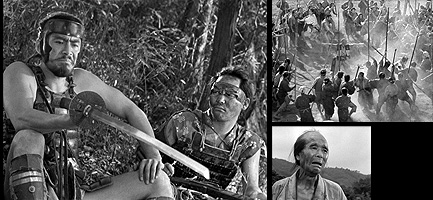
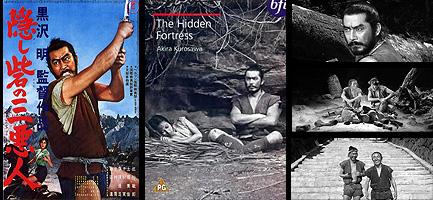
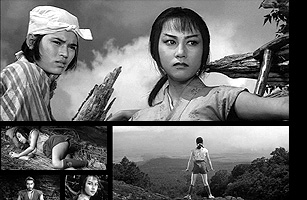
Another of Kurosawa's 1950's widescreen classics, The Hidden Fortress is a beautifully-shot and fast-moving adventure about a couple of low-lifes who stumble out of a war and into a plot to smuggle a princess and some gold through enemy lines. Toshiro Mifune plays one of his butchest roles as General Rokurota Makabe and the two low-lifes are played by Minoru Chiaki and Kamatara Fuijiwara (both in Seven Samurai). Big surprise is the princess - played by Misa Uehara - who is not
only very cute, but also pretty much became the clone stamp for the archetypal Japanese super manga babe. Such are her striking looks.
Light-hearted film
From the opening scene onwards it becomes clear that The Hidden Fortress is
quite a light-hearted, humourous film - even if there is a lot of suffering in the story. This can be attributed, primarily, to Chiaki and Fujiwara's characters (Tahei and Matakishi respectively)
‘which the film revolves around (these two characters, incidentally, were the inspiration for R2D2 and C3PO in George Lucas' Star Wars, and it's easy to see why). Mifune even puts in a subtle comedic performance as the general, further underpinning the light-hearted tone of the fillm.
qualities. The bone chinking “Mickey Mousing” music accompanying the infamous scene of the dog trotting by with the severed hand in it’s mouth is an apt prelude to the foreboding of Sanjuro’s signature theme. It makes you smile, only: nervously. The drums, strings and woodwind are in perfect unison from the moment the rousing opening sequence begins. Sato’s music makes you feel as though something amazing is happening. And, let's face it: something is.
An absolute classic
To us it's surprising that Yojimbo isn't shown on TV more often - it's a truly entertaining film that isn't too gruesome by today's standards. That said: it's easily available on DVD with a PG rating. Owning a copy of Yojimbo must be a priority for any Kurosawa fan and thankfully there are some good DVDs around, with plenty of extras. We do have to ask though: will there ever be a high def version? We can but hope.
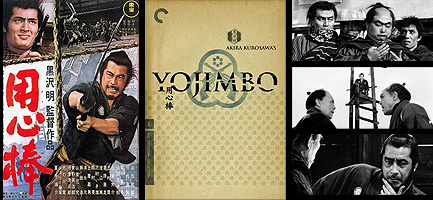
You may never have seen Kurosawa’s classic Yojimbo before, though you’re sure to have seen it elsewhere. Such is it’s influence. Re-made many times – sometimes legally (Last Man Standing), sometimes illegally (A Fistful of Dollars) – but never bettered, Yojimbo’s qualities rarely fail to meet or exceed expectations. The story of a samurai stirring up trouble in a town full of gangsters, Yojimbo has a visual style; a sense of irony and humour, and a pace of action unlike no other,
and it’s clear to see how it raised the benchmark for film-makers back in 1961 when it was first released.
Visually stunning
Much has been said about Yojimbo’s camera work, though only a viewing of the film can properly demonstrate how good it actually is. Kurosawa, Kazuo Miyagawa (Director of Photography) and Takao Saito (Assistant Cameraman) outdid themselves in their work – making full use of the
‘Tohoscope’ widescreen format with extreme framing, accentuating many famous scenes. A highly unusual use of angles; the skilled use of long telephoto lenses, coupled with ambitious moving camera shots, all combine to make something marvellous to watch.
Wonderful music
Composer Masaru Sato was asked by Kurosawa to create a theme for the main character in Yojimbo that had supernatural almost ‘voodoo’
qualities. The bone chinking “Mickey Mousing” music accompanying the infamous scene of the dog trotting by with the severed hand in it’s mouth is an apt prelude to the foreboding of Sanjuro’s signature theme. It makes you smile, only: nervously. The drums, strings and woodwind are in perfect unison from the moment the rousing opening sequence begins. Sato’s music makes you feel as though something amazing is happening. And, let's face it: something is.
An absolute classic
To us it's surprising that Yojimbo isn't shown on TV more often - it's a truly entertaining film that isn't too gruesome by today's standards. That said: it's easily available on DVD with a PG rating. Owning a copy of Yojimbo must be a priority for any Kurosawa fan and thankfully there are some good DVDs around, with plenty of extras. We do have to ask though: will there ever be a high def version? We can but hope.
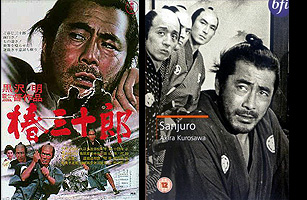
The popularity of Yojimbo led to a sequel being released the following year, and Sanjuro is it. Mifune returned as the titular main character - a Ronin (masterless samurai) at a loose end and with a penchant for getting involved in other people's business. Tatsuya Nakadai also returned as the film's primary bad guy, only this time with less hair and without a pistol.
Lighter tone
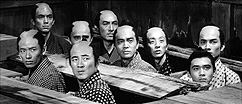
Like Yojimbo, Sanjuro is primarily a comedy, and although the tone of the film is far less bleak than it's predecessor it's not unfair to say that the body count is probably higher. This time Mifune's character stumbles upon an unfolding conspiracy in which a group of young and naive samurai are ensnared in a plot to
frame their master. Full of hubris and with an initial distrust of Sanjuro, the samurai are gradually shown the error of their ways as the flea-bitten hero both helps (and often humiliates) them by showing the way, and killing lots of baddies in the process.
Camera mastery
Although Kurosawa was not able to employ the services of master cameraman Kazuo Mayagawa this time around the visual richness of Yojimbo follows over into this film. Again: use of the widescreen framing, camera positioning and movement are brilliantly realised - particularly when Sanjuro and his eight young disciples are onscreen at the same time. Cinematographers Fukuzo Koizumi and
Takao Saito do a particularly good job of transforming potentially
static 'discussion' scenes into wonderfully-shot set pieces. As usual: Kurosawa's script, and editing are marvellous throughout and further accentuate the quick pace with which this film unfolds.
A worthy successor
Sanjuro, it could be argued, is every bit as good as it's prequel.
Masaru Sato's brilliant music makes a welcomed return, as do the cast who are mesmerising to watch. By the time the film reaches it's often talked-about ending, the viewer is nothing if not completely satisfied they've been thoroughly entertained. And the action, when it comes, is breath- taking in it's intensity - as you would expect. Sanjuro is an essential part of any Kurosawa fan's DVD library.